
Shopping Cart
- News
- 3 likes
- 924 views
- 0 comments
Leg Wraps (Winingas, Wickelbänder) in the Early Middle Ages
A Practical Garment and a Symbol of Historical Authenticity
Leg wraps—also known by the Old English name winingas and the German terms Wickelbänder or Wadenwickel—were among the most characteristic elements of men's clothing during the Early Middle Ages. In our next article, we'll take a closer look at leg wraps worn by women.
Although most people associate them primarily with the Vikings, their history stretches back much further. They were widely used throughout the Germanic, Anglo-Saxon and later Scandinavian worlds. Archaeological finds, together with period artwork, demonstrate that leg wraps provided a simple yet remarkably effective way of protecting the lower legs from cold, damp weather and everyday wear.
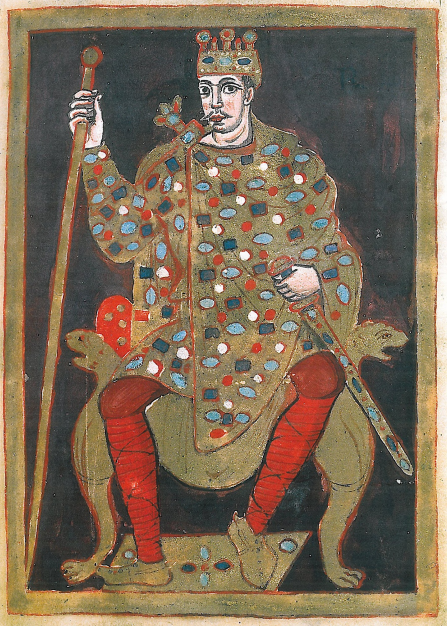
Lothair I (795–855), grandson of Charlemagne and son of Emperor Louis the Pious.
What Are Leg Wraps?
Leg wraps are long, narrow strips of woven woollen cloth wrapped spirally around the lower leg, either from the ankle to just below the knee or in the opposite direction. Unlike modern socks or knee-high stockings, they required virtually no tailoring—their quality depended primarily on skilled weaving.
Typical characteristics include:
- approximately 7–10 cm (3–4 in) wide,
- a recommended length of 3–4 metres (10–13 ft),
- woven directly to the required width rather than cut from a larger piece of cloth,
- made primarily from wool,
- woven in plain weave, twill, herringbone, or broken diamond twill.
Archaeological Finds from Hedeby
The best-known surviving examples of leg wraps come from the Viking trading centre of Hedeby (Old Norse: Heiðabýr; German: Haithabu) in present-day northern Germany. Between the 9th and 11th centuries, Hedeby was one of the most important trading towns in Northern Europe. Thanks to exceptional preservation conditions, it has yielded an extraordinary collection of textiles that provides valuable insight into Viking Age clothing.
Textile archaeologist Inga Hägg identified several fragments of leg wraps recovered from the harbour deposits at Hedeby. These remains indicate that at least two principal types were in use:
- narrower wraps woven in plain weave or twill,
- broader wraps woven in a distinctive herringbone pattern.
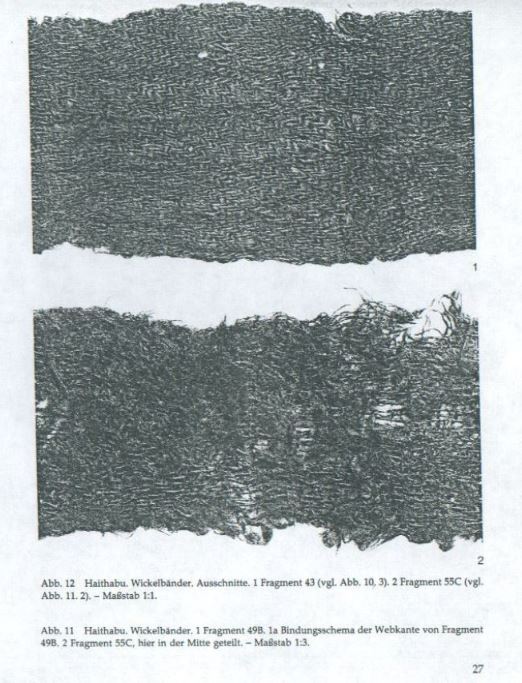
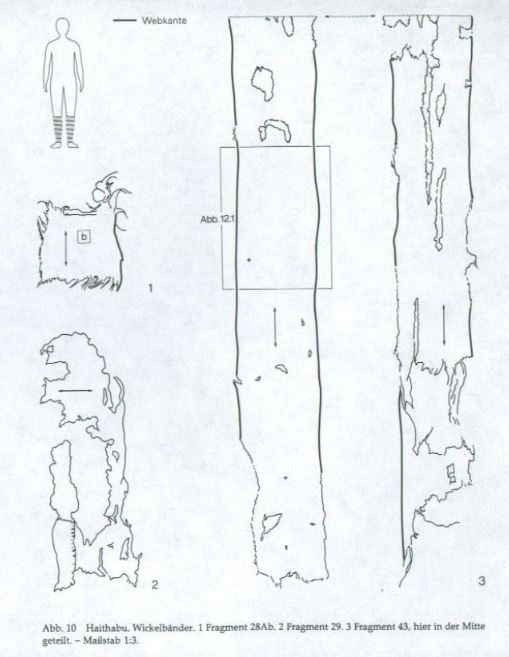
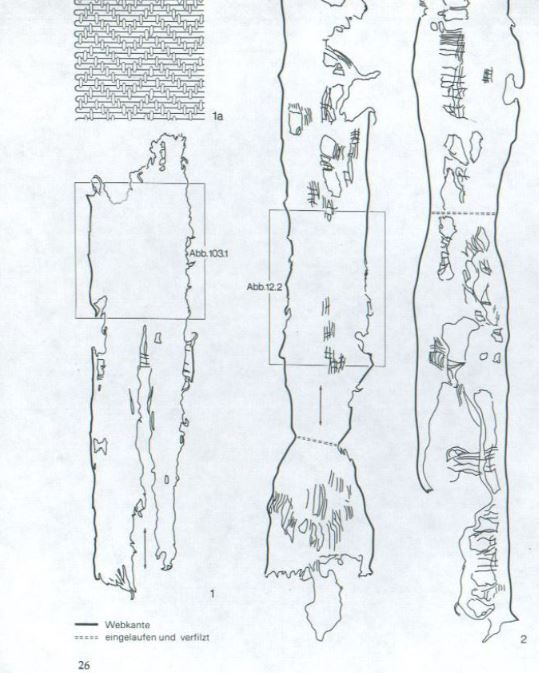
Although no complete pair has survived, all of the fragments share a remarkably similar construction, suggesting that leg wraps were a standard element of everyday dress rather than an unusual accessory.
What Were Leg Wraps Used For?
Their purpose was above all practical.
Protection Against the Cold
Wool is an excellent insulator, even when damp. Wrapped calves stayed warm during winter travel and everyday outdoor work.
Protecting Trousers
Early medieval trousers were valuable garments. Leg wraps protected the lower legs of the trousers from abrasion caused by grass, undergrowth and even the saddle while riding.
Speaking from experience: Fine wool trousers are far less likely to snag on blackberry brambles when protected by leg wraps!
Supporting the Lower Legs
Firmly wrapped calves received additional muscular support, much like the military puttees of the late nineteenth century or modern compression wraps.
Protecting Footwear
When wrapped over the instep, leg wraps also helped prevent mud, snow and small stones from finding their way into shoes or boots.
How Were Leg Wraps Worn?
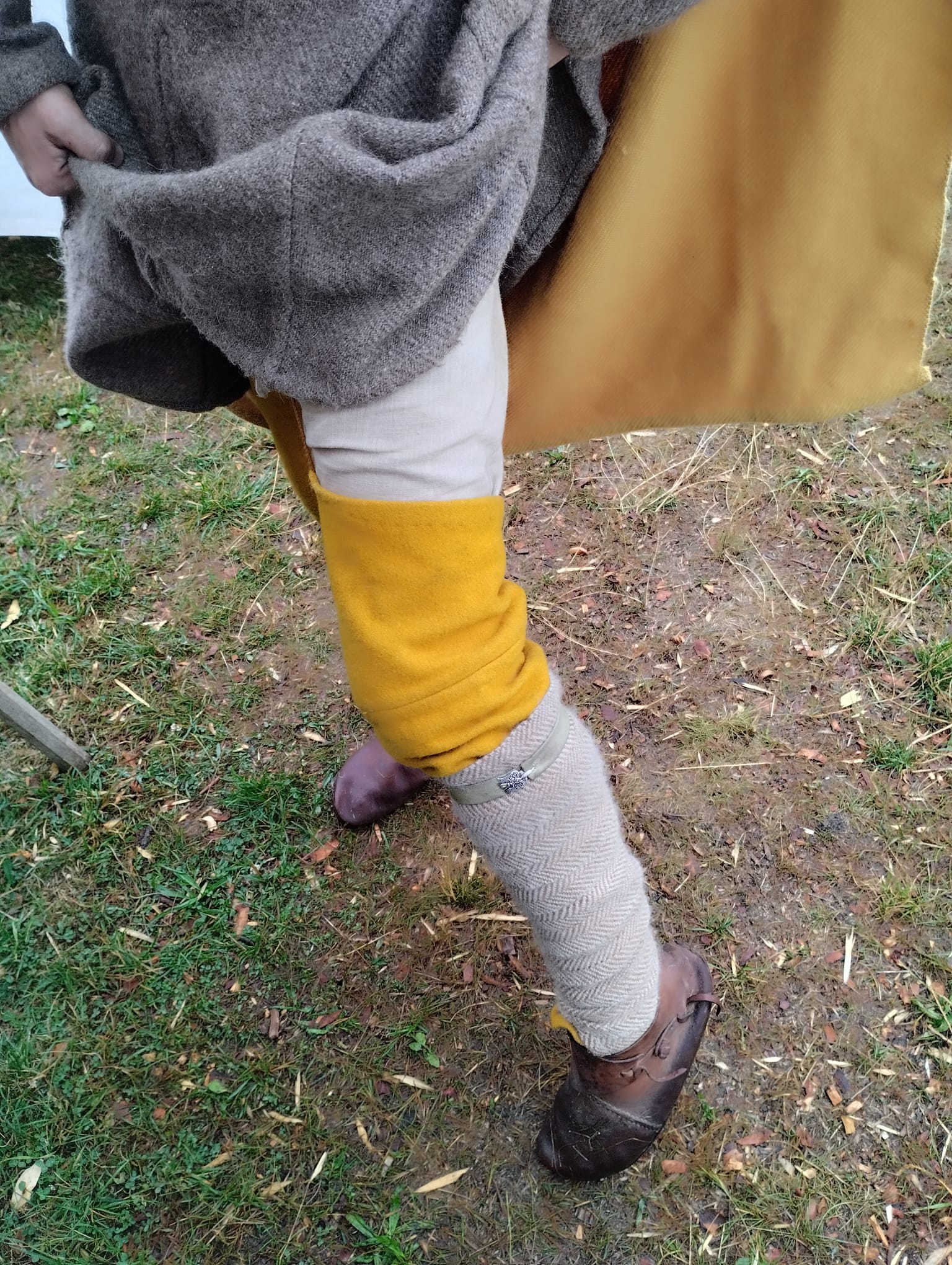
The exact method of wearing leg wraps remains a topic of discussion among historians and reenactors alike. One thing is certain, however: period artwork depicts them on both noblemen and ordinary people.
From the Ankle Upwards
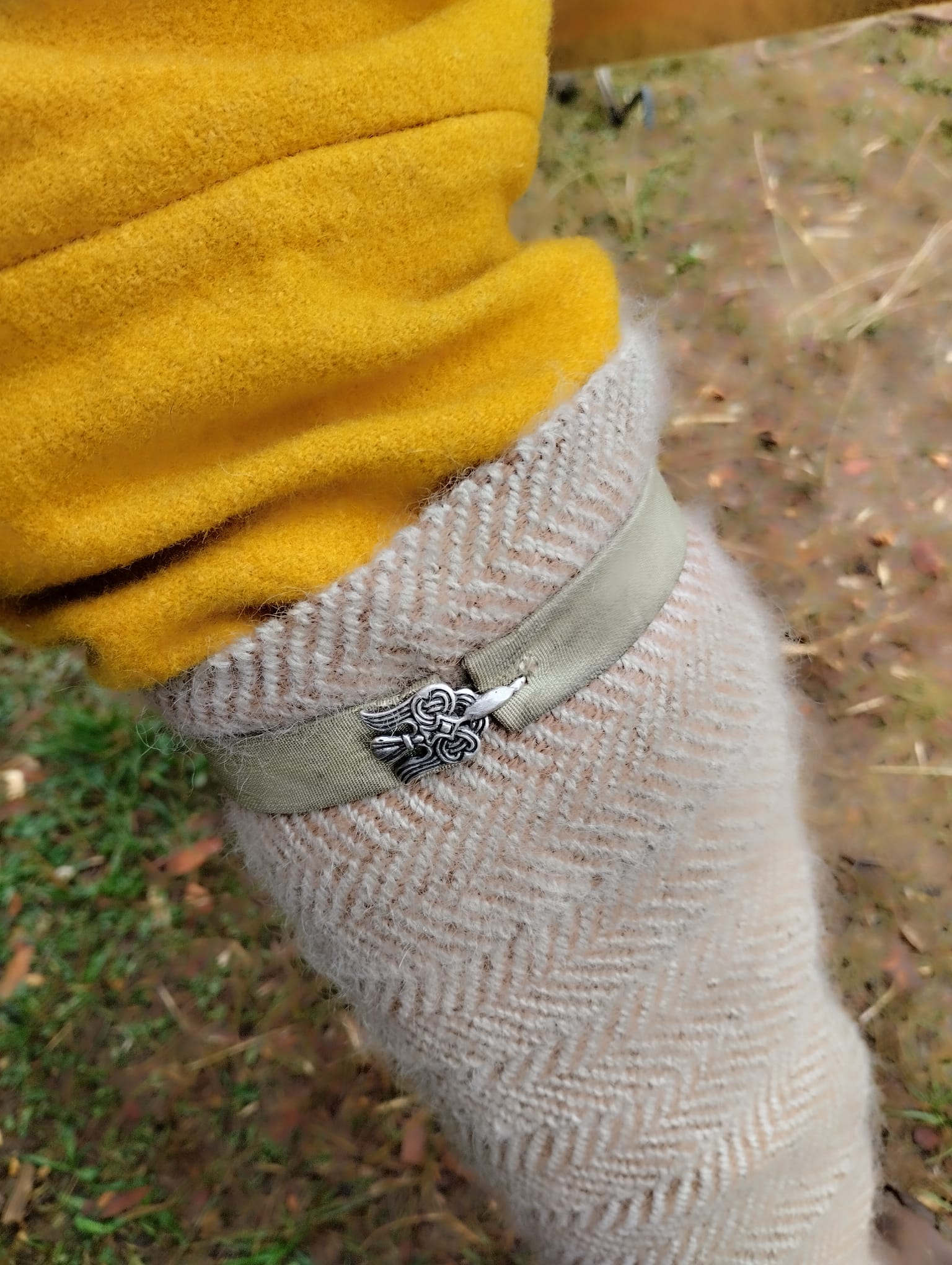
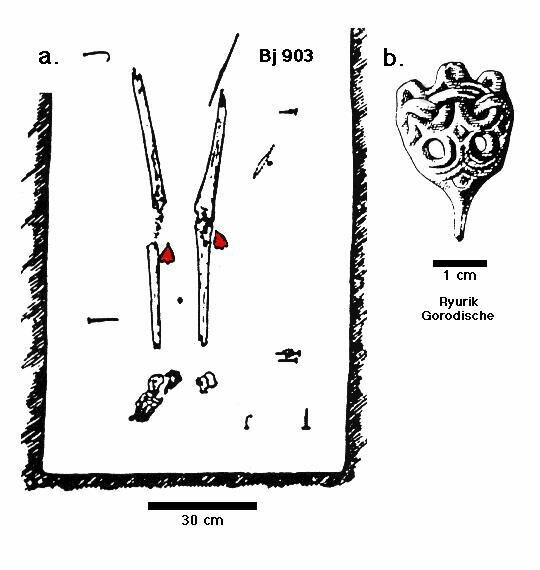
This method closely resembles the military puttees used during the nineteenth and early twentieth centuries. The wrap begins at the ankle and is wound upwards in overlapping spirals until it reaches just below the knee, where it is secured with a small metal hook or another type of fastening—a topic we discussed in an earlier article.
This interpretation is supported by the discovery of small metal hooks from Scandinavia, Kievan Rus' and the British Isles, many of which are believed to have been used specifically for fastening leg wraps.
From the Knee Downwards
More recent reconstructions based on the Hedeby finds suggest another possibility. In this version, the wrap starts just below the knee and is wound down towards the ankle. The end is then tucked beneath the foot or into the shoe.
The rough texture of wool creates enough friction to keep the wrap securely in place, even without a hook or other fastening.
Many reenactors favour this method because it is exceptionally comfortable and reliable. Practical experience has shown that it performs extremely well during long hikes, historical events and physically demanding work.
Were Leg Wraps Exclusively a Viking Garment?
Absolutely not.
Leg wraps first appear during the Roman period and were later adopted by various Germanic peoples. Their use continued throughout the Migration Period and remained common during the Early Middle Ages.
They are known from:
- Anglo-Saxon England,
- Viking Age Denmark,
- the Frankish Empire,
- and several regions of the Holy Roman Empire.
One of the best-known visual sources is the Bayeux Tapestry, dating from the eleventh century, where leg wraps can clearly be seen on numerous figures.
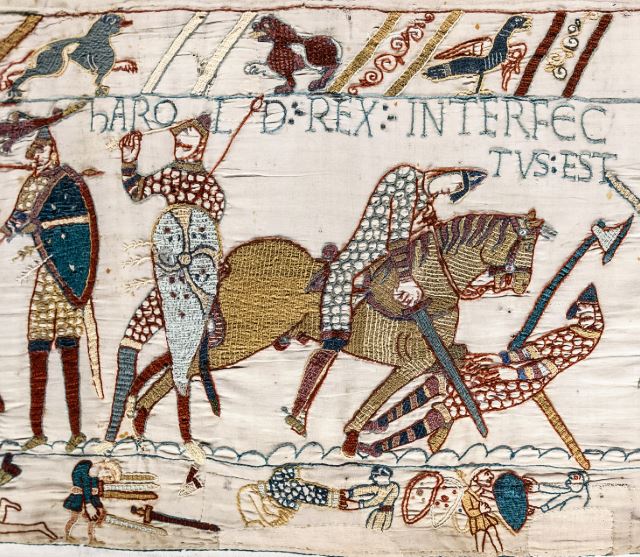
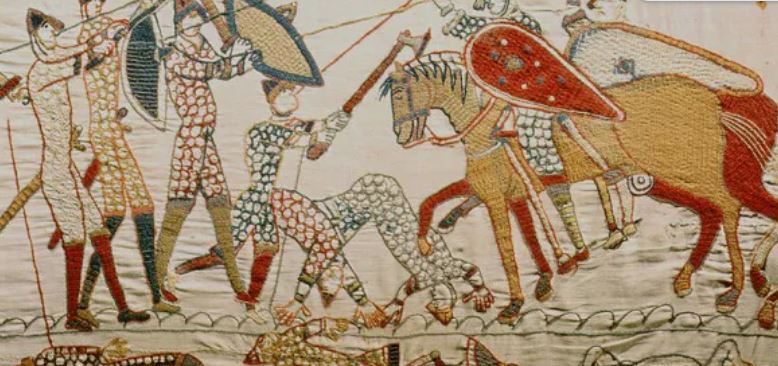
Their widespread appearance across Europe demonstrates that they were not a uniquely Scandinavian garment, but rather a practical solution shared by many early medieval cultures.
Which Colours Should You Choose?
The original dyes used on the Hedeby textiles cannot always be identified with certainty. Nevertheless, archaeological evidence suggests that natural shades were by far the most common.
Typical colours include:
- grey,
- brown,
- natural white (the colour of undyed sheep's wool),
- ochre and yellow, obtained from readily available dye plants,
- muted greens,
- and reddish-brown tones.

In the colour chart, the crossed-out shades represent expensive luxury dyes, while the remaining colours can be achieved relatively easily using traditional natural dyeing techniques.
Rich, saturated colours—especially red and blue—required costly dyestuffs and considerably more labour. They would therefore have been far less common among ordinary people.
However, if your impression represents a wealthy merchant, a high-status warrior or a member of the nobility, don't be afraid to add a little colour.
And why not dress your entire household troop in matching colours? Let everyone know that your lord can afford it. ? Wink, wink.
Leg Wraps in Modern Reenactment
Today, leg wraps are considered an essential part of the kit for most reenactors portraying the 9th–11th centuries. They are not only well supported by archaeological evidence, but they are also incredibly practical in everyday use.
For an authentic reconstruction, we recommend:
- using 100% wool,
- choosing a plain weave, herringbone, or diamond twill,
- a width of approximately 8–10 cm (3–4 in),
- a length of 3–4 metres (10–13 ft).
A practical tip: If your leg wraps keep slipping, they're usually too short. Saving money by buying half a metre less simply isn't worth it—choose a little extra length instead.
Just as importantly, avoid cutting them from ordinary cloth and hemming the edges. Historically accurate leg wraps were woven to their full width with finished selvedges, not cut from larger pieces of fabric.
How Should Leg Wraps Be Fastened?
Over the years, reenactors have developed several reliable methods of securing leg wraps.
Omega Brooch
A small omega-shaped brooch offers a quick and simple solution. It's easy to use, dependable, and for many reenactors has become second nature.
Sewn-on Hooks
Perhaps the most common method today. Small iron or bronze hooks are sewn directly onto the end of the wrap and hooked into the fabric.
It is practical, secure and well supported by archaeological finds.
Hook Attached to a Tablet-Woven Band
Many experienced reenactors prefer sewing a short length of tablet-woven braid to the end of the leg wrap and attaching the hook to the braid rather than directly to the wool.
The hook then catches the braid instead of the wrap itself, reducing wear on the wool and creating a more secure fastening.
It's one of those small improvements that you begin to appreciate once you've been doing reenactment for a few years.
Leather Straps
Decorated or undecorated leather straps can also be used as garters, secured with either hooks or small buckles.
Functional, durable and visually impressive.
Reenactor Level: Master.
Conclusion
Leg wraps may appear to be a small and rather inconspicuous detail, yet they were an essential part of early medieval clothing.
Archaeological discoveries—most notably from Hedeby, but also from many other sites across Europe—together with period artwork demonstrate that they were worn throughout the early medieval world, not only by the Vikings.
Simple, durable and highly practical, leg wraps protected the lower legs from cold and damp, prolonged the life of valuable clothing and provided additional comfort during travel, work and military activity.
Thanks to the combined evidence of archaeology, historical artwork and experimental archaeology, we now understand that leg wraps were far more than just a distinctive "Viking" accessory. They were everyday clothing worn by people who spent much of their lives outdoors in the demanding climate of northern and central Europe.
Finally...
If you're looking for authentic woven and naturally dyed leg wraps, as well as high-quality reproductions of historical hooks, brooches and buckles, you'll find them HERE.
Comments (0)